· Nadia Rahman
Violin hickey and neck pain: what the mark means and how your setup causes it
Two complaints walk into a lesson together: a mark under the jaw that a scarf has been hiding, and a neck that aches by the end of practice. This page reads them as one mechanical cause, decided mostly by what sits between the violin and your collarbone. It is not a diagnosis and does not replace one.
What the mark actually is
Fiddler’s neck is an area of thickened, darker skin on the side of the neck below the angle of the jaw, where the chin rest meets the body. A 2004 review of skin conditions in instrumental musicians (Gambichler et al., BMC Dermatology) describes the usual picture as lichenification and hyperpigmentation, with redness, scaling and small bumps possible on top. Lichenification is what skin does when it is rubbed repeatedly: it thickens and darkens. That is the mark most players mean by a violin hickey.
The same review gives the cause as a combination: friction produces the thickening, while local pressure, shearing stress and occlusion, skin held against a surface with sweat trapped between, can produce the acne-like bumps and, in some players, cysts. Poor hygiene adds a risk of local infection. Viola players are thought to be more prone because the instrument is larger and heavier: more weight carried by the jaw, more mark.
of 116 violinists and violists surveyed at German music universities reported fiddler’s neck, and instrument-related skin problems were significantly more common with high practice frequency and professional status
— Gambichler et al., Contact Dermatitis (412 musicians), 2008
A 2023 review from a musicians’ medicine centre in Berlin (Zinn-Kirchner et al.) relays a two-type distinction. Type 1 sits under the jaw and is the mechanical mark: pressure and shear stress on the skin, a flat darkened patch or a rougher, thickened one. Type 2 sits lower, toward the collarbone, and more often shows an allergic, itchy contact dermatitis caused by the metal brackets that fasten the chin rest to the violin. The first answers to how you hold the instrument; the second to a clinician and an allergy test. Everything below is about type 1; the last section covers type 2.
Where the pressure comes from
The violin sits on the collarbone. Your jaw is some distance above it, more for a long neck, less for a short one, and that distance has to be closed by something or the instrument slides. When nothing fills it, the body improvises: the left shoulder rises to push the violin up, the head comes down to pin it, and the jaw becomes a clamp. A clamp presses, and it shears, because every shift of the left hand tugs the instrument against the skin holding it. Pressure, shear and occlusion under a warm chin rest: the recipe from the previous section, produced by a gap.
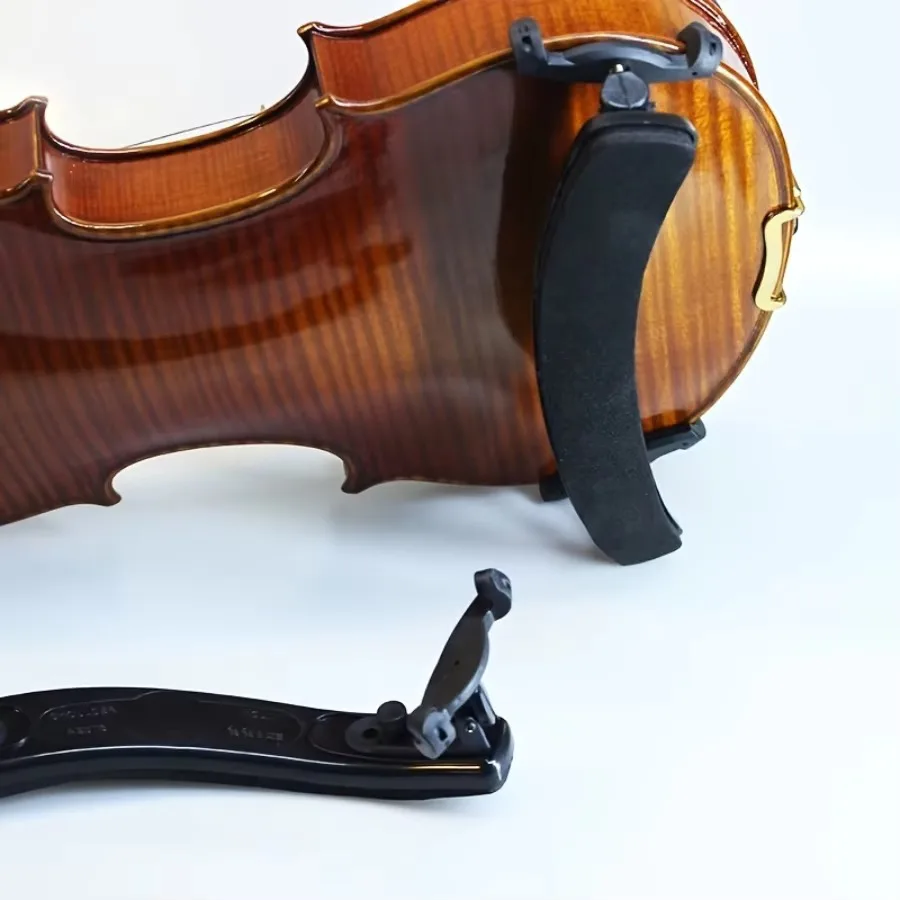
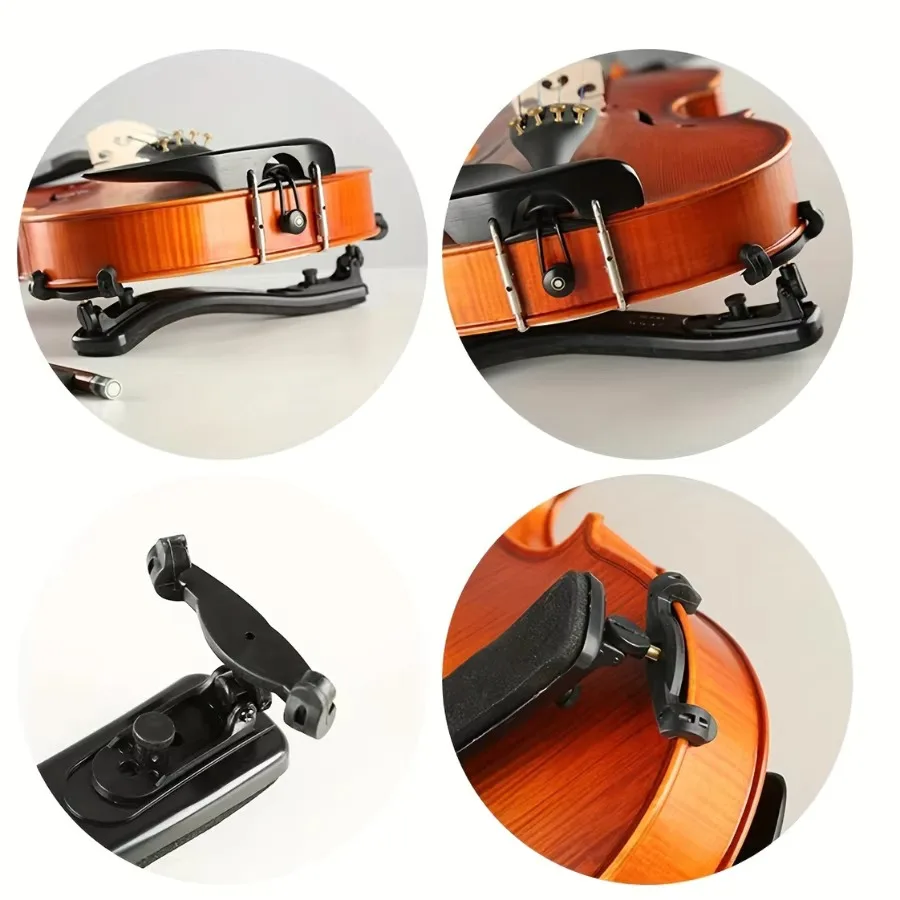
A shoulder rest fills the gap from below. Ours does it with a foam-cushioned arch over a slim metal core, a fixed 4.4 cm tall, on two feet that hook onto the ribs and pivot for width and angle. Once the arch carries the instrument, the head no longer has to. It rests on the chin rest instead of pressing on it, and the contact under the jaw drops from a grip to a touch. The mark and the sore neck are both downstream of that drop.
raising the shoulder rest raised the jaw-to-shoulder force players used to fix the violin and the activity of the left front shoulder muscle, and lowered rated comfort: the hold is a measurable load, and the rest sets it
— Kok et al., Medical Problems of Performing Artists (20 professional violinists), 2019
The caution runs the other way too: taller was not better in that study, so filling the gap is not the same as stacking it. The arch on our rest is low and does not change; what you set is the span and tilt of the feet, and the procedure for finding the setting where the head rests without effort is in our guide to using a shoulder rest for posture.
Why the mark and the sore neck arrive together
The clamp has three parts, and only one touches skin. The jaw pressing down leaves the mark; the shoulder rising to meet the violin and the neck bending left and holding there are the parts that ache. All three are one decision, made in the first second of every session: the instrument is not supported, so support it with muscle. A player with a violin hickey is a player whose left shoulder and neck are working.
of the 276 high-string players in a survey of 1,470 musicians reported pain in the shoulder and neck, alongside 45% with headache and 20% with jaw-joint pain
— Van Selms et al., cited in Zinn-Kirchner et al., Journal of Multidisciplinary Healthcare, 2023
Numbers like that show where string playing puts its weight; they are not a promise about any accessory. A hold that carries the instrument from below asks less of exactly those muscles, and the mark is the part of that load you can see in a mirror.
Reading the mark against your hold
This is how I read the two symptoms in a lesson. None of these rows is a diagnosis; they are questions for your setup, and the last row goes to a clinician.
| What you notice | What it usually points to | What to check |
|---|---|---|
| Mark present, neck fine | Friction alone, from many hours of contact | Clean contact and the tilt of the pad |
| Mark plus a shoulder that creeps toward the ear | The gap is being closed by muscle from below | Whether the rest is seated on the ribs and filling the gap at all |
| Mark darkens after long sessions, fades in a week off | Cumulative pressure and occlusion | Breaks inside long practice; how hard the head presses |
| Mark sits further forward, toward the chin | The head pressed to pin a sliding instrument | Feet seated fully, rest size matched to the violin |
| Sore neck with no mark | Shoulder and neck holding the violin, jaw barely involved | Whether the arch is filling the gap for your neck length |
| Itchy, weeping, or shaped like the metal fitting | Possible allergic reaction to the chin rest hardware | A clinician and an allergy test, not a setting |
A sore neck with no mark is the more telling case: the jaw is not clamping, so the shoulder is lifting to meet an instrument with nothing under it. A mark that fades in the holidays and returns with lessons usually means a setup rebuilt by eye each session and compressing as the hour goes on; see sponge versus shoulder rest.
Four setup checks that lower the load
In the order I run them. Each lowers the pressure the jaw applies, which is the only lever that reaches both symptoms.
- Confirm the rest is carrying the violin. Head resting on the chin rest, let go with the left hand for a second. A seated rest that fills the gap holds the violin on its own for that moment; if the instrument dips, the jaw has been holding it. Reseat both feet fully on the ribs; the motion is in how to put a shoulder rest on a violin.
- Match the rest to the violin, not the player. A rest too large for the body cannot close its feet on the ribs, so it slips, and a slipping rest is the fastest route to a clamped jaw. Our full model spans 20.3 cm for 4/4 and 3/4 violins, the small model 15.8 cm for 1/4 and 1/8; the sizes guide explains the half size and how to measure.
- Set the tilt so the pad meets the shoulder along its length. A pad balanced on one edge rocks, the violin rolls toward the floor, and the head presses harder to stop it. The feet pivot for angle: turn them until the foam sits flat against the slope of your chest. The arch height is fixed, so this is the setting that does the work.
- Drop the shoulder and re-test. With the arch carrying the instrument, let the left shoulder hang and turn the head to rest rather than press. If the shoulder rises again within a bar, the question is span and tilt again, or, for a very long neck, our guide on who a shoulder rest suits.
Between sessions: skin, cloth and the badge myth
The dermatology review is blunt about hygiene: irritated skin under a chin rest can get infected. Wipe the chin rest after playing, wash the neck, and do not practise in a collar that traps sweat against the mark. This is not treatment; it is looking after a callus.
Many players keep a thin cloth between skin and chin rest, and the musicians’ medicine review lists a cloth among the options, depending on what is causing the mark. It reduces friction, not pressure; if the mark still spreads, the pressure is still there, and the pressure is the hold. The same review names proper education as one of the most vital preventive measures, and puts the responsibility on teachers to find chin and shoulder rests fitted to the player and to insist on rest during intensive practice periods.
It names something else too: the idea, widespread in the playing world, that fiddler’s neck is a badge of diligent practice, and says that notion would need to be dismantled for healthier playing. A mark records how many hours the jaw has been clamping, not how many hours the player has been improving.
When to stop adjusting and see someone
- The mark itches, blisters, weeps, or follows the outline of the metal fitting on the chin rest: the picture of type 2, which a clinician can test for.
- The mark becomes a firm lump, or keeps growing after the pressure has dropped.
- Neck pain that persists between sessions, or on days you do not play.
- Pain that spreads into the left arm, or any tingling or numbness in the hand or fingers.
- Pain in a child or young player.
Bring the instrument: a clinician who can see the hold has an easier job than one working from a description.
Keep reading: the buyer’s guide, and real buyer reviews from players who fitted ours.
Questions
What is a violin hickey?
It is the patch of irritated skin on the left side of the neck, just below the angle of the jaw, where the chin rest presses and rubs. Dermatologists call it fiddler’s neck. Friction thickens and darkens the skin, and pressure, shear and trapped sweat can add redness or small bumps.
Does a shoulder rest help with a violin hickey?
It changes the one thing that sets the pressure: how hard your jaw has to hold the violin. When the rest fills the space between collarbone and instrument, the head rests instead of clamping and the chin rest presses less. Skin that is already irritated still needs time and clean contact to settle; what the rest does is lower the load that produced the mark.
Why does my neck hurt after playing violin?
The usual pattern is a hold that relies on muscle: shoulder raised to lift the violin, head pressed down to pin it, neck bent left for the whole session. Those efforts tire the neck and left shoulder, and they are the same efforts that press the chin rest into the skin. Pain that persists between sessions, or comes with tingling or numbness, is a reason to see a doctor.
When should I see a doctor about a violin hickey or neck pain?
See a clinician if the mark itches, blisters or weeps, follows the outline of the metal fitting of the chin rest, becomes a firm lump, or keeps growing after the playing pressure has dropped. For the neck: persistent pain, pain spreading into the arm, or any tingling or numbness in the hand is a medical question, not a setup question.
Free shipping · 30-day money-back guarantee