· Nadia Rahman
Sponge vs shoulder rest: when the cheap fix holds you back
This is a comparison of two objects, not a debate about whether anything belongs between you and the violin. That question has its own page. What follows is narrower: a sponge and an adjustable rest fill the same space by different means, and the difference only shows up after a few weeks of playing.
What a sponge actually gives you
Let us give the sponge its due, because it earns it. Held against the back of the violin with an elastic band, a kitchen sponge or a folded cloth does the one thing that matters most: it occupies the air between the instrument and your collarbone. With that space filled, the violin has something to sit on, and your left hand stops being a support column and goes back to being a hand.
It has three real advantages. It costs nothing, so no decision has to be made before the first lesson. It can be cut with scissors, so a shape that suits one shoulder is trimmed to suit another in about a minute. And nothing clamps to the instrument, which reassures a parent handing a rented violin to an eight-year-old.
Those are genuine strengths, and they are all strengths of the first few weeks: available immediately, free, and easy to change. Notice what they have in common. Every one of them is about getting started. None of them is about what happens once you have started, and that is the part this page is really about.
Why it turns up in the first weeks
Two practical reasons, and both are about the beginner rather than the accessory.
The first is anatomy. A small child has almost no gap between jaw and collarbone, so there is little for anything to fill, and the goal is the least lift that stops the violin sliding. A thin piece of foam delivers exactly that. The second is timing: a young player changes instrument size every year or two, so a re-cuttable shape fits the season better than one bought to a measurement.
There is measured support for keeping the lift modest rather than generous. Researchers who varied shoulder-rest height found that raising it increased the force players used to fix the violin and the muscle activity in the left shoulder, and the players themselves rated the taller settings as less comfortable.
raising shoulder-rest height increased violin fixation force and shoulder muscle activity, and players reported lower comfort
That finding is why the sponge has survived in teaching studios, and why a low, fixed arch is a sensible target rather than a compromise. Which school your own tutor belongs to is a separate matter, set out in our guide to whether a beginner should start with a rest.
The setting a sponge cannot keep
Think about what a sponge setup actually consists of. A piece of foam of a certain thickness, placed at a certain point on the back of the violin, at a certain angle, held by a band under a certain tension. Four variables, none of them marked, all of them set by hand and by eye. When you take the violin off your shoulder and put it in its case, all four are gone.
Tomorrow you rebuild them from memory. You will get close, because your shoulder remembers more than you think, but close is not the same, and the gap between close and same is where the trouble lives. Foam compresses too, so the shape you set at the start of a session is not the shape you have forty minutes in. The setup drifts within a session as well as between them.
For the first weeks that hardly matters. It starts to matter when your playing becomes precise enough that a small change in the angle of the instrument shows up in your intonation or your bow contact point. At that stage you want the variable removed, not re-estimated.
What a fixed arch and pivoting feet change
An adjustable rest attacks exactly those four variables by turning them into settings that stay set.
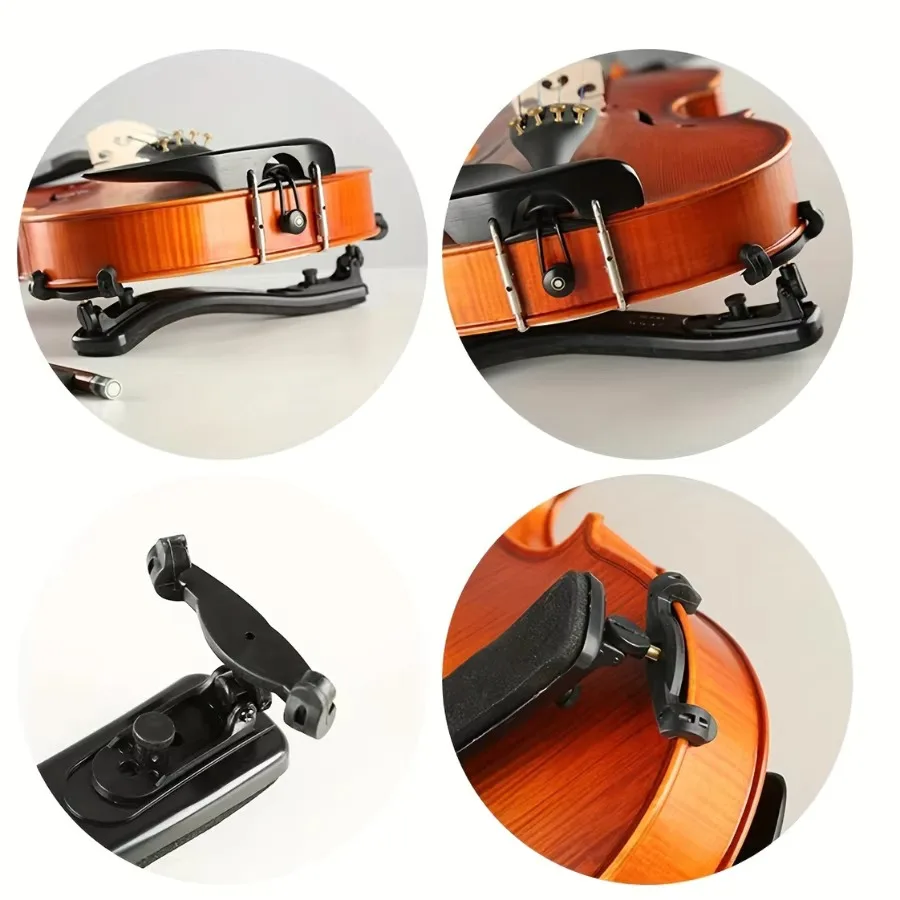
The arch on ours is a fixed 4.4 cm from the feet to the top of the pad, and the big model spans 20.3 cm. Fixed is the operative word: it is a low rest, not a height tower, and that number is the same on Monday as it was on Friday. What does move is the pair of feet, which pivot on thumbscrew joints for span and for tilt. You set them once, and the joints hold the position through fitting, playing, folding and packing.
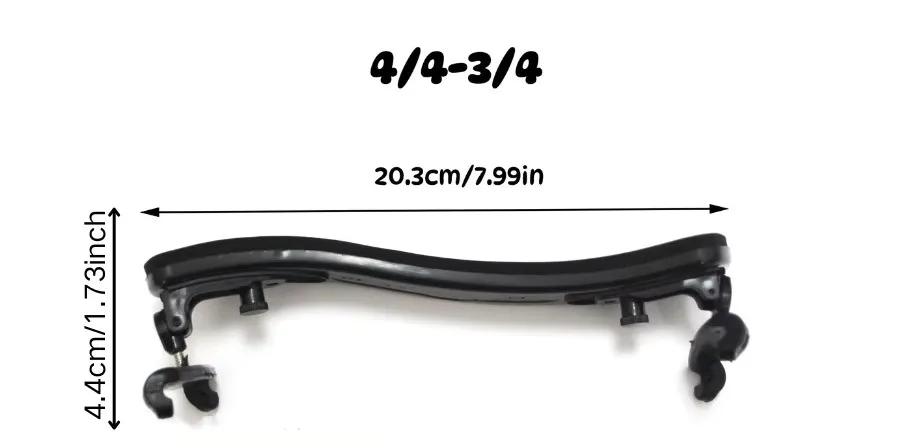
That is what converts a daily rebuild into a daily habit. Fold the feet in and the curved bar goes flat for the case; unfold them and the span and tilt are exactly where you left them. Nothing is re-estimated, and nothing has to be re-learned at the start of a practice session. The mechanics of setting it the first time are in our setup guide, and what to look for while you play is in the posture guide.
There is a second, quieter gain. Because the position survives the case, you can change one thing at a time and hear the result: widen the span slightly, play the same passage, decide. With a sponge that experiment never runs cleanly, because the thing you changed and the thing you rebuilt are the same thing.
Slipping, and what the hook feet do about it
The complaint that brings most players to look for a rest is not comfort. It is the sponge sliding.
An elastic band around the body of a violin has to be tight enough to hold foam in place and loose enough not to press on the plates, and those two requirements pull in opposite directions. Play with any vigour, shift position, and the pad works its way toward the lower bout. Most players respond by gripping harder with the jaw, which is the exact habit any support is meant to prevent.
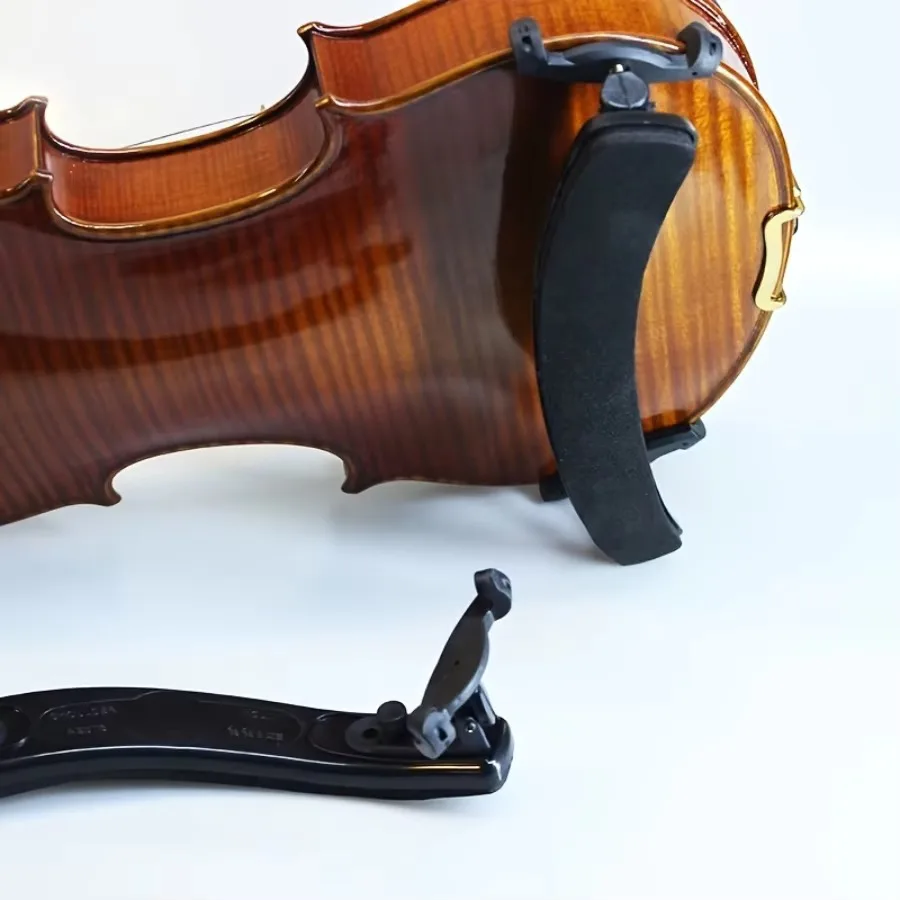
A clip-on rest solves it differently. Its two feet hook over the edges of the lower bout, so the load runs through the ribs, a structural part of the instrument, rather than through a band stretched over the arching. It stays where you put it for the length of a session. That grip is for playing rather than storage, which is why the rest comes off before the case shuts, as our guide on packing a violin case sets out.
The faults a rebuilt setup lets through
These are the things a teacher spots across a room, why they happen, and what a setting that holds does about each one.
| What shows up | Where it comes from | What a held setting does |
|---|---|---|
| Shoulder creeps toward the ear | The gap is being closed by muscle, not by the pad | The arch fills the same space every session |
| Violin angle differs day to day | The pad was re-placed by eye | Tilt is set on the joints and stays there |
| Pad migrates during practice | An elastic band over a curved back | Hook feet grip the edges of the ribs |
| Support fades late in a session | Foam compresses under the jaw | A fixed 4.4 cm arch over a metal core |
| Intonation wanders after a break | The instrument returned at a new angle | The same geometry after every unfold |
| Chin presses down to stop a slide | The pad is moving and the jaw compensates | Nothing to chase, so the jaw can rest |
None of these is dramatic on any single day. They matter because practice is cumulative, and so is the strain that comes with holding an instrument up.
prevalence range of playing-related musculoskeletal disorders in string players across studies
— Systematic review, Journal of Manipulative and Physiological Therapeutics, 2018
A setup you can trust is the cheapest form of prevention available to a learner, because it removes a decision you would otherwise make badly, quickly, and twice a day.
Sizing your first rest to the violin
One rule governs the switch, and it is the rule players get wrong most often: the rest follows the instrument, never the player's age.
Our big model spans 20.3 cm and is built for 4/4 and 3/4 violins. The small model spans 15.8 cm and covers 1/4 and 1/8. The half size falls between the two and neither model covers it, which we say plainly on the sizes guide, along with an age chart and how to measure your own instrument. On a 3/4, set the feet to their narrowest position before the first fitting.
Then give yourself one sensible first session. Fit the rest, seat both feet firmly on the ribs, and play something you know well before adjusting anything. Your shoulder has been reading a sponge for weeks and needs a few minutes to read a different shape. Change one setting, play the passage again, keep what you prefer. That is a conversation you can only have with an accessory that remembers its answers.
Ours is $24.95 with free shipping, arrives in about 6 to 10 business days, and carries a 30-day money-back guarantee, so the first session can happen on your own shoulder rather than in a shop. What it gives you is support that lands in the same place, at the same angle, every time you pick the violin up. That is the thing a learner can build on.
Keep reading: whether you need a shoulder rest at all, how to hold the violin and bow, our buyer's guide, and real buyer reviews. Or shop the adjustable Cadenza rest in both sizes.
Questions
Can you use a sponge instead of a violin shoulder rest?
Yes, and many players start that way. A sponge held on with an elastic band fills the space between the violin and the collarbone, costs nothing and can be trimmed to a small player. What it does not do is hold a shape: it compresses as you play and it is rebuilt from scratch every time you take it off.
Why do violin teachers start pupils with a sponge?
Because it is available in the first lesson, it can be cut down to a child in seconds, and nothing clamps to the instrument. For a young pupil whose violin changes size every year or two, that flexibility matters more than precision. Our guide on whether a beginner should start with a rest covers both teaching schools.
Is a shoulder rest better than a sponge?
A rest gives you something a sponge cannot: a setting you can return to. The thumbscrew joints hold the span and the tilt you set, and the arch is a fixed 4.4 cm, so the shape you played yesterday is the shape you get today. A sponge gives you a fresh approximation each morning.
How do I switch from a sponge to a shoulder rest?
Fit the rest, set the feet to the narrowest position that seats firmly on the ribs, and play a familiar piece before changing anything. Size the model to the violin, not to your age: our big model spans 20.3 cm for 4/4 and 3/4 violins, the small one 15.8 cm for 1/4 and 1/8.
Free shipping · 30-day money-back guarantee